
How Bench Warrants Work in Swift County
Bench warrant is plain English, not a Minnesota docket label. It names a judge-issued warrant that follows a court obligation someone failed to meet. The court file itself will say failure to appear or sign-and-release instead. Two records can sound identical on the phone yet carry completely different consequences. That is why reading the file matters. Swift County runs a single trial court, so there is no separate bench-warrant court to call. The same district court handles the criminal, traffic, family, juvenile, and civil matters that other places split among a city court, a county court, and a justice of the peace. What differs is the case and the judge's order. The building stays the same.
What a Missed Swift County Hearing Can Trigger
Skipping a hearing is the most common route to a bench warrant in Swift County. It is not the only one. What follows depends on the notice served, the charge behind the case, whether this is a first failure, and whether anyone raised a safety concern. Those details drive the outcome.
- A missed district court appearance, which is the classic case
- No response to a summons that was served or mailed
- A violation of release conditions set at an earlier hearing
- Contempt or another failure to follow a court order
- An unpaid traffic or ordinance matter where the court takes further action
Which of these did the judge enter? Court administration has that answer. A phone call beats a guess, because the record shows the actual event that landed in the file. Note: One missed date can bring a new hearing notice in one case and a warrant in another Swift County case.
Bench Warrant Issuance in Swift County
A district court judge issues the warrant under the same rule that governs arrest warrants, and that rule prefers a summons. The preference drops only when a response is unlikely, the person's location is unknown, or imminent harm requires an arrest. A missed date alone does not create one. Once the warrant exists, an authorized agency serves it. In Swift County the sheriff's office covers court orders and arrest warrants, while Benson and Appleton police handle the city-level contacts and Kerkhoven and Murdock receive service through a sheriff contract. The serving agency does not decide anything. Only the court file settles a warrant's status.
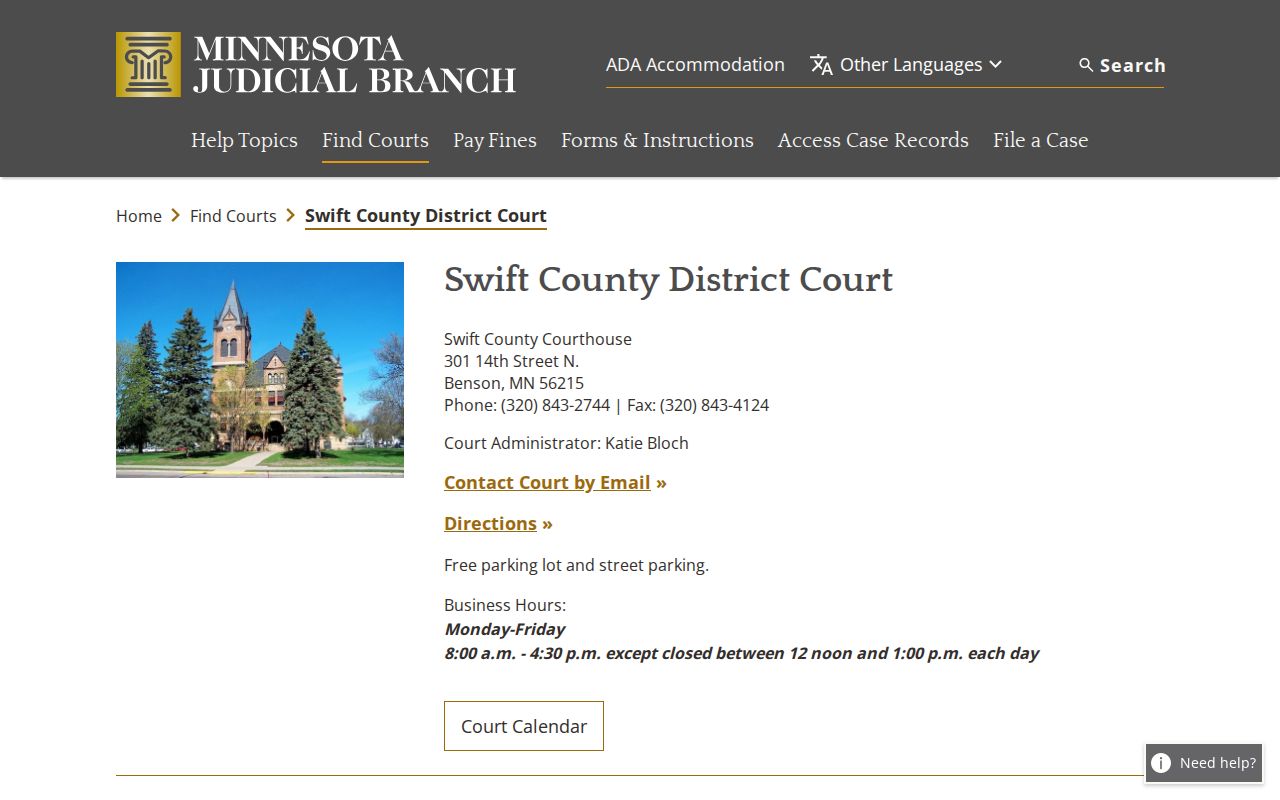
The Swift County District Court page lists the courthouse address, contact numbers, and weekday hours. The noon closure for court offices is listed too.
The Court Calendar Is Not a Warrant Check
Swift County posts its court calendar at 7:00 a.m. each business day. It updates hourly. Lobby copies are called the most current version. Some readers treat a missing name as proof a hearing was cancelled. It is not. The court warns that the calendar omits confidential and non-remote matters, so a case can be fully active and simply absent from the list. Use it to confirm when and where to appear. A warrant question needs the case file or a phone call. The same goes for the state court system's hearing search. It lists scheduled proceedings, not warrant status.
How Bench and Arrest Warrants Differ
The two warrants behave differently on a stop. They start in different places. An arrest warrant rests on probable cause from a charging document, while a Swift County failure-to-appear warrant rests on what did or did not happen in a case already open.
| Question | Arrest Warrant | Failure-to-Appear Warrant |
|---|---|---|
| What starts it | A complaint supported by probable cause | A missed appearance or other court obligation |
| Who signs it | District court judge | District court judge |
| Arrest authority | Authorizes arrest | Depends on the type; a sign-and-release warrant does not |
| Bail | Bond or conditions may be set | None required for a sign-and-release warrant |
| Typical next step | Counsel, appearance, bond | A new court date, or bond if the court requires it |
Sign-and-Release Warrants for a Qualifying First FTA
Minnesota carved out a narrow path. It covers a small set of first failures to appear, and the labels are the ones the court and the statute actually use. Knowing them makes a call to Swift County Court Administration far more productive.
- Failure to appear
- Not showing up for a required court time after notice or an order was served.
- Sign-and-release warrant
- A statutory warrant for a qualifying first failure that does not authorize arrest and does not require bail.
- Summons
- A notice requiring a court appearance. The rules generally prefer it over a warrant.
- Inactivation
- The step that closes a sign-and-release warrant after the officer gives written notice of the new date.
- Bond forfeiture
- What a missed appearance can cost someone who was already released on bond.
The statute applies when a summons was issued and mailed service came back undeliverable. The person then failed to appear. No earlier failure can exist in that case. The charge must qualify too, and a prosecutor can still show that bail is needed for victim or public safety.
Clearing a Bench Warrant in Swift County
Read the actual court event before you spend money or take a day off. The right fix depends on the warrant. A sign-and-release warrant calls for a new appearance notice. An arrest warrant may take counsel, a voluntary appearance, or bond. Ask Court Administration which one applies, and ask whether the court expects a motion, a payment, or an appearance. Swift County publishes none of the usual shortcuts. There is no walk-in surrender window, no recall form, no bond schedule, and no posted fee for a motion, so nobody can promise what a counter visit will cost or produce. Call the court at 320-843-2744. Call the sheriff at 320-843-3133. Get the instruction for your case, and bring the case number.
Call first: court offices close from noon to 1:00 p.m. on weekdays, and no walk-in warrant or bond procedure is published for Swift County.
Confirming a Bench Warrant Is Inactivated
A court event does not update the public record right away. Say you posted bond, filed a motion, or got a new appearance date after a failure to appear. The Register of Actions catches up on the court's own schedule. Until then, a Swift County online record can keep showing the old status on that bench warrant. Two steps close the loop with Court Administration. First, ask when the file should reflect the change, then check the case record again once that date passes. If you want proof in hand, request a public copy of the order. Keep the paperwork with the case number handy, because one missed date later can reopen the same warrant question in a hurry.
Swift County Courts That Issue Bench Warrants
One court issues every bench warrant here: the Swift County District Court in Benson. It sits at 301 14th Street North, with Court Administration reachable at 320-843-2744. The court holds original jurisdiction over criminal, traffic, civil, family, juvenile, and probate matters filed in Swift County. That single-court structure catches some readers off guard. People often expect a separate city or municipal court for a traffic ticket. In Swift County, though, a city ordinance or traffic citation still routes to the district court unless the ticket itself directs otherwise. So read the citation first. It controls which agency gets your first call, and the district court holds the file either way. One call to 320-843-2744 covers the case file and the warrant question whenever a notice names Swift County District Court.
Juvenile and Family Bench Warrants in Swift County
Juvenile and family bench warrants in Swift County run through the same district court, but the access rules change. These case files are treated as private or confidential. State juvenile records law bars most electronic public access too. So a bench warrant lookup through the public case search may simply never display the record. A parent, guardian, or attorney can still reach it through a different route than the general public. Court administration will tell you which path applies. An attorney can deal with the underlying case as well.