
Swift County Warrant Searches
No Swift County agency offers a public warrant search box. The sheriff posts duties, not names. No city department puts out a roster either. So the state court system is the only electronic public route left. It works as a case search rather than a warrant list, which is why the channels below matter. Each one answers a different question, and the court file settles the status in the end.
- Open Minnesota Court Records Online and choose the case search tab.
- Enter the citation or case number if you have one. If you do not, try the exact legal name with and without a middle initial.
- Read the Register of Actions for a warrant event, a missed appearance, or a later recall or inactivation.
- Call Swift County Court Administration at 320-843-2744 to confirm what the file shows today.
- Call the Swift County Sheriff's Office at 320-843-3133 about service or custody, and file a written records request if the file is not online.
Why a Case Number Beats a Name in Swift County
Names collide in Swift County. Families here share surnames and street addresses, and a court file keeps the name exactly as it was typed years ago, misspellings and all. A citation number skips past that problem entirely. The state system adds a wrinkle too: some pending criminal matters will not come back on a defendant name search, so a case can exist while the name search returns nothing. A citation number, an attorney name, or an attorney bar number will still reach it. Note: An empty Swift County name search means a missing identifier, not proof that no case or warrant exists.
What a Warrant Search Asks For
The public search form offers more than a name box. Most fields are optional. A Swift County query can run as narrow as a citation number or as broad as a county-wide name sweep.
| Field Label | Type | Required | Notes |
|---|---|---|---|
| Person | Tab and text box | Yes when selected | Exact name; try a middle initial |
| Business | Tab and text box | Yes when selected | Exact business name |
| Case Number | Text | Yes when selected | Numbers, letters, and hyphens, with no spaces |
| Citation Number | Text | Yes when selected | Often the only route into a pending matter |
| Attorney Name | Text | Optional | Searches by the attorney on the case |
| Attorney Bar Number | Text | Optional | Another route into a pending matter |
| Date Filed | Date or range | Optional | Narrows the result list by filing date |
| Case Status | Dropdown | Optional | Options appear in the live interface |
| Court Locations | Check boxes | Optional | Statewide or one county |
| Find | Button | Not applicable | Runs the search |
| Clear | Button | Not applicable | Resets the form for the next search |
Swift County searchers can start with the Judicial Branch overview, which describes four search types.
Wildcards and the Swift County Name Search
Two spelling aids are built into the Swift County search, and they cannot be combined. The asterisk stands in for the rest of a surname once you have typed at least two characters, so a prefix search pulls up the longer spellings. The Sounds Like option hunts for names that start with the same letter and sound close to what you entered. Common surnames still generate the longest lists, so pair a wildcard run with a date range or a court location when the form allows it. When neither tool finds the case, the record is usually the problem rather than the spelling. The matter may not be posted yet, or it may belong to another county's court.
Swift County Warrant Search Results
A result list shows case-level information first. Open a case and the Register of Actions appears beneath it. Read the identifier rows, then the status rows, because the entry that matters in a Swift County file may sit several lines down.
| Case Number | The file number for the case, or the citation number for a traffic matter |
|---|---|
| Warrant Event | The entry showing a warrant was issued, with its date |
| Warrant Type | Arrest, failure to appear, or sign-and-release, as the record labels it |
| Charge or Offense | The offense and statute behind the case |
| Issuing Court | Swift County District Court, with the judicial officer on the file |
| Bond or Release | Conditions or an amount set by the court; confirm the figure |
| Status | Active, served, recalled, quashed, inactivated, or discharged |
| Access Marker | Whether the record is available remotely or only through the courthouse |
The Swift County Court Administration Call
Court administration turns a search result into an answer faster than anything else. The office sits in the Swift County Courthouse at 301 14th Street North in Benson. Call 320-843-2744 on weekdays from 8:00 a.m. to 4:30 p.m., closed from noon to 1:00 p.m. Staff can read an ambiguous event for you and explain what the court requires next. Have your identifiers ready before dialing: legal name, date of birth, and the case or citation number. Ask plainly whether a warrant is active, what type it is, and which court event comes next. If a record is not online, the same office explains the courthouse inspection route.
Swift County Warrants: Who Holds What
Different Swift County offices hold different records, and each counter answers a different question. Knowing which one to call first keeps a simple inquiry from turning into three transfers.
| Office | What It Holds | How to Reach It |
|---|---|---|
| Swift County District Court | Case files, hearing records, court orders, certified copies | 320-843-2744 in Benson |
| Swift County Sheriff's Office | Service and custody questions, jail records, civil process | 320-843-3133 at the Law Enforcement Center |
| Benson Police Department | City citations and incident records | 320-843-4790 |
| Appleton Police Department | City citations and incident records | 320-289-2356 |
| Kerkhoven and Murdock service | Sheriff contract patrol and dispatch for both cities | 320-264-5972 for Kerkhoven dispatch |
Swift County Warrant Status Terms in Plain Language
A Swift County case history uses short labels that decide your next move. Read the status line before anything else on the page.
- Issued
- The court signed the warrant. On its own, this says nothing about whether anyone has served it.
- Served
- The warrant was executed or delivered to the person named on it. The case itself continues.
- Recalled
- The court called the warrant back. Ask when the public record updates to match.
- Quashed
- The court set the warrant aside without dismissing the charge behind it.
- Inactivated
- The warrant was made inactive, including through the statutory sign-and-release procedure.
- Forfeiture
- A release or bond entered after a missed appearance. Money can be lost and new court action can follow.
Which Warrants Stay Restricted
Minnesota law does not treat every warrant record the same way. Some data becomes public the moment it is created. Some stays closed until a court event opens it up. The unserved warrant index is the clearest example of the closed category. A state statute on law-enforcement data sets that rule, and Swift County court administration can explain which classification applies to a particular file without disclosing what it may not release.
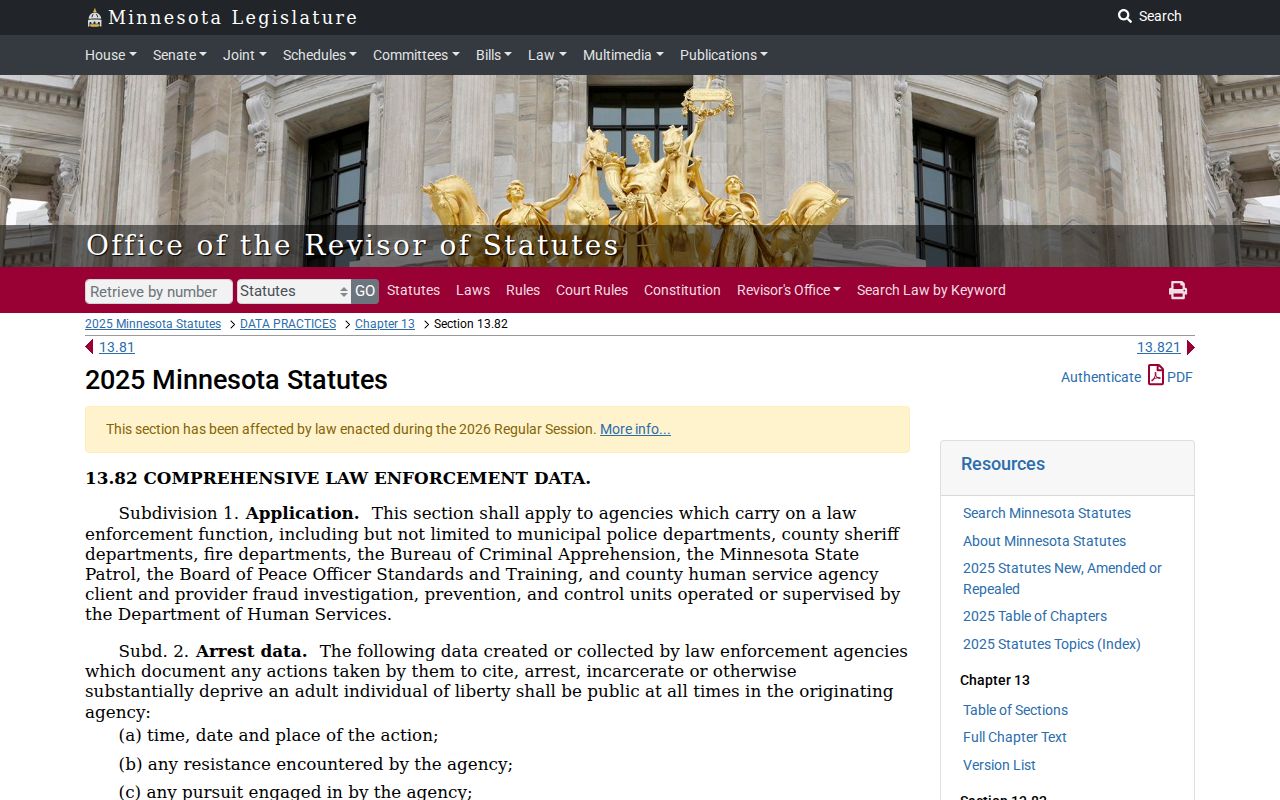
The wording comes from the state's section 13.82 text. That statute also lists which adult arrest data stays public at the originating agency.
Key Rules:
An arrest-warrant index may stay confidential until custody, service, or a court appearance, so a missing online entry proves nothing.
Juvenile court orders, including warrants, are private or confidential under state law and carry their own access limits.
Sealed and expunged files sit outside public access, and a records request cannot reopen them.
Search warrant documents are a different category from arrest warrants and are not available in the public case search.
A Chapter 13 Request for a Record That Is Not Online
When a file is public but simply not posted, the written request route starts on the county data page. Under the Minnesota Government Data Practices Act, you may inspect public data at no charge and pay only allowable copy costs. Name the record, give a date range, include the case or citation number, and state the format you want. Keep the request narrow. A Swift County custodian does not have to build a new report listing every warrant in the county, answer a legal question, or release protected material. If the county denies the request, it must identify the classification and the statute it relied on when you ask in writing. When a warrant does turn up, the county overview lays out the steps that follow.